
John L's Comet and Eclipse Photos
|
A Few Comets |
|
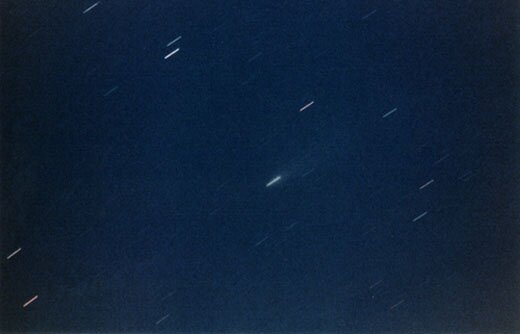 |
Comet Halley was one of those sky objects I could not see with the naked eye unless I looked slightly to the side of it. And that's not really seeing it – is it? This pre-dawn time exposure was taken on March 22, 1986 with a 210 mm telephoto lens set at f4, Ektachrome 400 film (pushed to 800), and an exposure time of about one minute. Here the comet appears below and to the left of the constellation Sagittarius. |
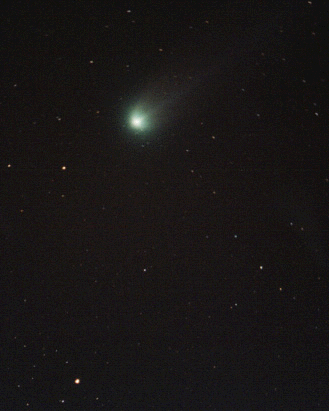 |
Here's my lucky shot of Comet Hyakutake on March 26, 1996. On this evening, one could actually sense the comet's movement to the left – relative to the stars – even with the naked eye. Photo was taken around 8:30 PM at Warner Park in Madison, WI in the midst of city and car lights – with 210 mm telephoto lens set at f4, Kodacolor Royal Gold 400 film, and an exposure time of approx. 2 minutes. Due to the proximity to Polaris, the bright star at the bottom, star drift was minimal, allowing for extended exposures without much, if any, streaking. This will probably be my favorite comet of all time, and what luck for an amateur astronomer to discover it in the first place! |
 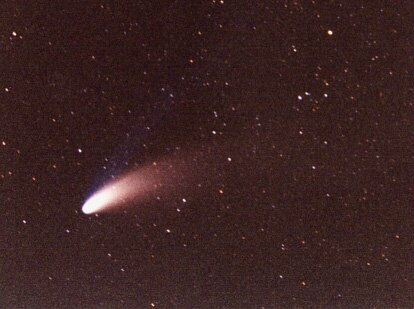 |
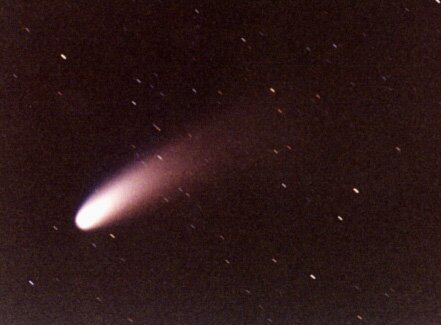
Having clear skies near Hayward, WI on the night of March 26, 1997 (exactly a year after the above photo), I got these shots of Comet Hale-Bopp after slogging through 2-3 feet of snow. Until the snowy season got generally shorter, warmer and drier – starting in the later 1990s – the larger snowdrifts would become "petrified" and hang around till May in the Hayward area. Both photos were taken with Kodacolor Royal Gold 1000 film and an exposure time of around 15 seconds at f4. Top photo taken with 70 mm lens, bottom with 210 mm. |
 |
|
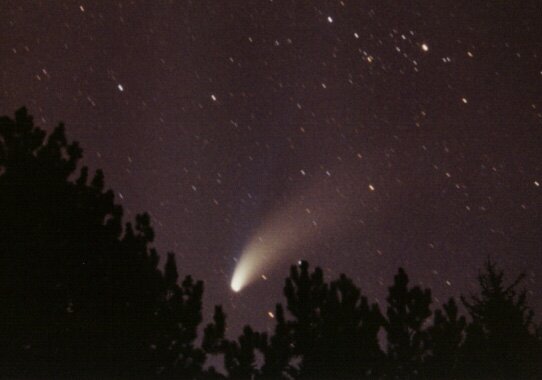 |
A parting shot of Hale-Bopp as it sets behind the trees near Hayward. Taken about 9PM on April 11, 1997 with the 70 mm lens set at f4, Kodacolor Royal Gold 1000, and an exposure time of about 10 seconds. |
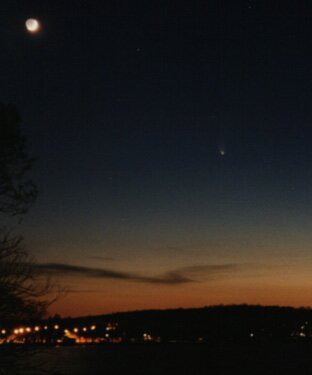 |
(Like Columbo, he's back with just one more thing.) Here is my final shot of Hale-Bopp, taken on May 9, 1997 at the UW-Madison campus with the 70 mm telephoto lens set at f4, Kodacolor Royal Gold 1000, and an exposure time of about 5 seconds. Anticipating some tail disruptions which were expected around this time, it appeared there were some momentary periods of brightening which I reported as such, but corroboration was not forthcoming. Hyakutake was a lot more fun for me anyway. |
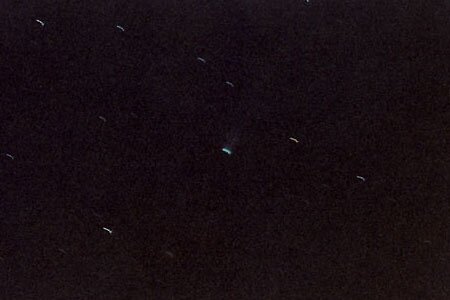 |
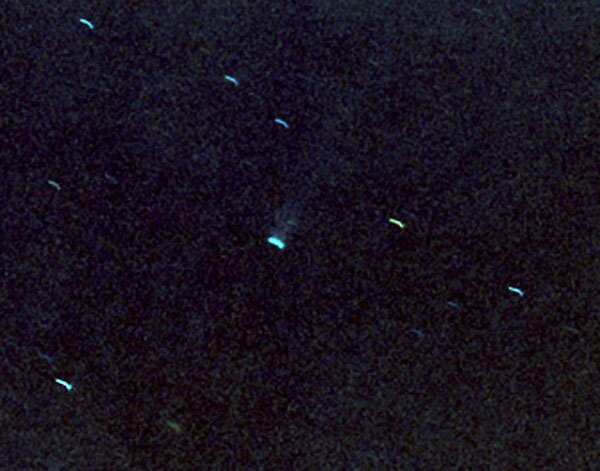
This time-exposure of Comet Ikeya-Zhang was taken April 5, 2002. Three problems: (1) the camera tripod sank a little into the snow during the exposure (hence the curved streaks), (2) the comet itself did not show up clearly anyway, and (3) the print was mistakenly made on matte-finish paper, causing a grainy image with my present scanner. I thought for some time that this photo (linked from the top image at left) was nothing more than a cheap souvenier of an otherwise-productive evening of star-gazing. However, upon closer inspection, it appeared that the tail (pointing up and to the right) did not smear out evenly as the comet's apparent image moved during the time exposure. There are localized bright streaks which could have been the result of tail rotation – i.e., as the earth's rotation caused the images of the comet and stars to appear to move laterally, a brighter part of the comet's rotating tail was in a relatively "fixed" position for several short time periods during the time exposure. (Click on bottom image at left for an enhanced-contrast "close-up.") Another one of my theories. At any rate, the erratic activity of this comet's tail can be seen graphically in this image from NASA's "Astronomy Picture of the Day." |
 |
|
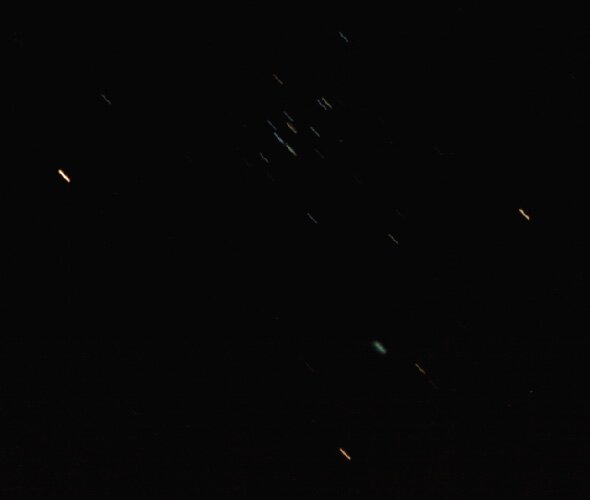 |
I was happy to get a fleeting glimpse and shot of at least one of the three comets visible in May, 2004. Here is a rough time exposure (approx. 30 seconds) of Comet NEAT taken on May 14, 2004 near Hayward where it was positioned just below (and to the right) of a cluster of stars called the "Beehive Nebula" in the western sky soon after sunset. |
|
The Great American Eclipse of 2017
|
A Few More Eclipses |
||
 |
 |
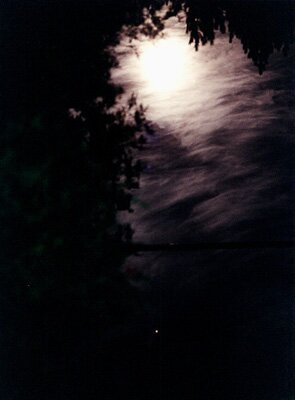
Here are a couple moon shots from March 23, 1997, the night of the partial eclipse. Photo at left was taken about an hour before the start of the eclipse, showing Mars* below the clouded moon. Right photo was taken about a half-hour before the eclipse reached its maximum. Not the clearest possible conditions for eclipse-watching, but apparently good enough. Both photos were taken near Hayward, WI with Kodacolor Royal Gold 1000 film and an exposure time of probably less than a second (I tend to forget) at f4. Left photo taken with 70 mm lens, right photo with 210 mm. |
 |
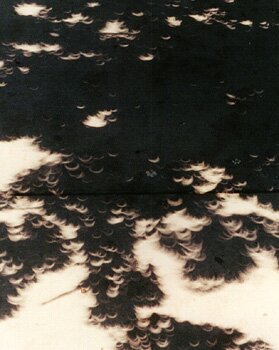 |
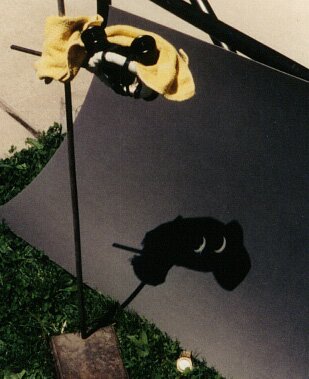
This is the solar eclipse of May 10, 1994 viewed outside the now-demolished E. B. Fred Hall at UW-Madison. I don't know from where I learned about this technique for the indirect viewing of solar eclipses, but it works best when the binocular image is projected into a shadow such as in the photo at left. (A neater setup is shown below.) The photo on the right illustrates the natural method: letting the leaves of a tree project the sun's image – filling the sidewalk with crescents! |
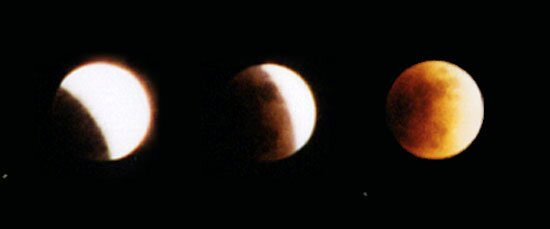 |
Here are three views of the Jan. 20, 2000 lunar eclipse as observed in Monona, WI. |
|
 |
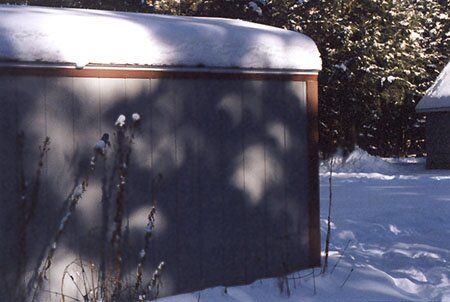 |
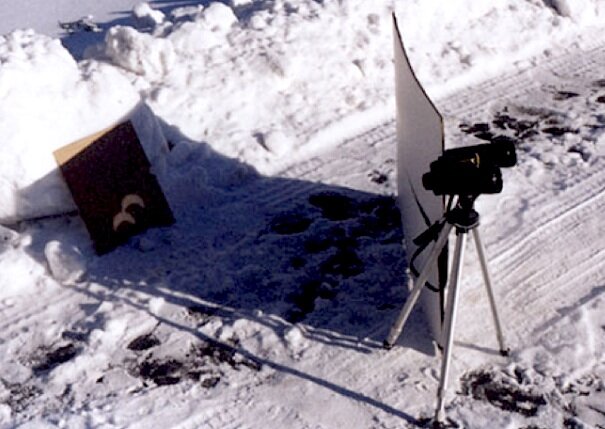
The solar eclipse of December 25, 2000 viewed near Hayward. Here the last eclipse of the second millennium was visualized by utilizing the same techniques employed in the May 10, 1994 eclipse above. |
|
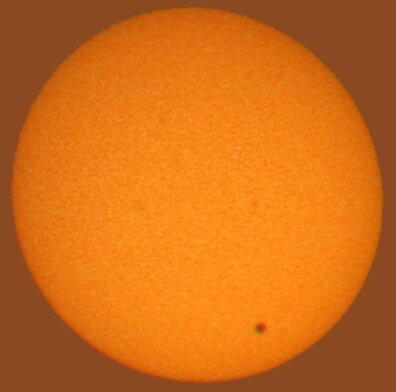
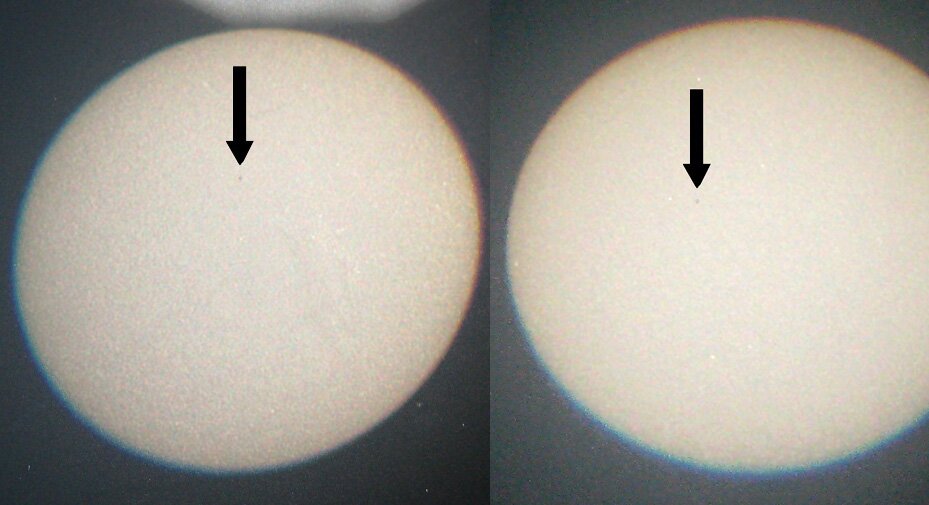
A Couple Historical Transits
|
|
SOME ASTRONOMY LINKS
|

|
This page originally featured just the Comet Hyakutake photo and was uploaded to the web This page was last modified on December 12, 2020 at 1:45 PM, CST. |