
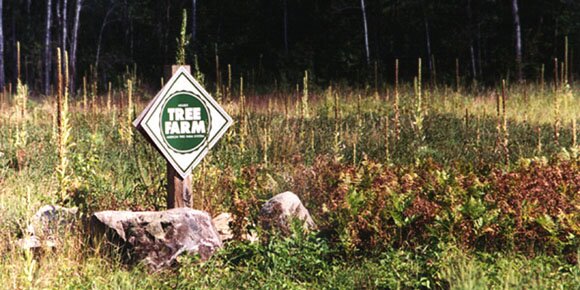
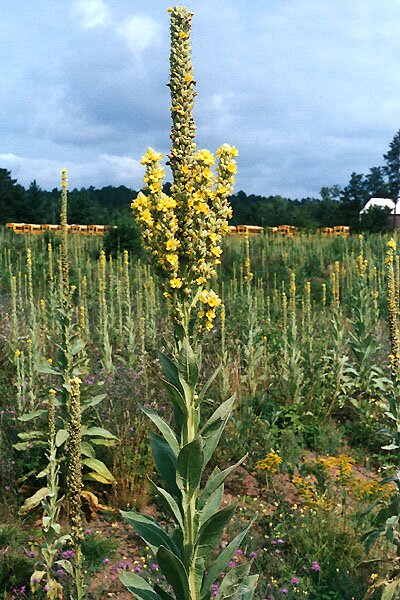
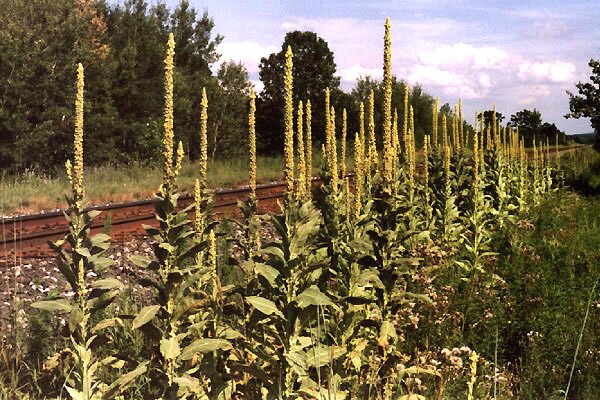
It is a bienniel, appearing as a rosette of fuzzy leaves in the late summer and fall of its first year and sending up a stem topped with a column of yellow flowers during the spring and summer of its second year. A grove of tall mulleins (termed a "choir of mulleins" as one refers to owls as a "parliament of owls") in the summer can be an imposing sight. The dead plants often remain standing well into the third year – littering the landscape like aggregations of giant, burned-out sparklers – and can probably shed viable seeds for years to come. Mulleins appear to thrive on nutrient-poor and recently-disturbed soil. A year after a tree-cutting operation one may find them growing profusely. Interestingly, a thick mullein stand tends to inhibit growth of subsequent patches at the same site for at least several years, although other plant species may not be so repressed. Once any fascination with the plant wears off, one might think that such land could be put to productive use by planting trees – or even giving sorghum a try. |
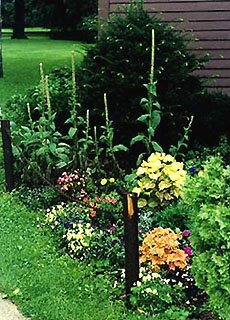 My nominee for State Weed of Wisconsin is the common or "great" mullein, a ubiquitous plant that tends to arouse widely opposing reactions regarding its esthetics and overall value. It is distributed throughout the world and known by a variety of names. An excellent (albeit biased) discussion of the plant can be found here. Hailed by its advocates as a source of remedies for a variety of ailments, it is discounted by others as yet another form of herbal quackery, as noted in E. Laurence Palmer's classic Fieldbook of Natural History (1949, McGraw-Hill). Of possible interest to microbiologists like myself are the bacteriocidal properties attributed to its flowers. The mullein is occasionally transplanted to gardens as an ornamental which may have been the case shown on the right for a garden outside a legendary brown church in Iowa (the one that's out in the vale). However, some regard the plant as overbearing and ugly and will uproot it at every opportunity.
|
|
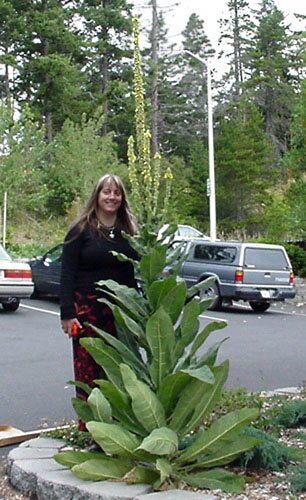 |
An Award-Winning Mullein! From the island of San Juan off the coast of Washington, Heather Bickford sent these photos of her prize mullein in July, 2001. It was later displayed at the San Juan County Fair (along with information on the medicinal value of mulleins) and won the blue ribbon in the herb category along with the people's choice award. One would probably not expect less for this fine 8' 7" specimen! |
 |
A Taller One!
Click on the images for full view in separate window.
Ken Strothkamp of Portland, Oregon sent some photos of his giant mullein.
 1 |
1: In the early spring, the huge rosette appears to be gearing up for a productive second year.
2: Ken is six feet tall, and by late August, 2018 his mullein had attained a height of 9 feet 10 inches.
3: Often a mullein will produce more than one flower spike and a "candelabra effect" may be observed as seen among the photos in the set below. Here we see two arising alongside the main (central) flower spike.
4: A view of the top of the main flower spike.
5: What appears highly unusual are the multiple small flowering offshoots along the entire course of the stalk. |
|
 2 |
 3 |
|
 4 |
 5 |
|
More Photos
Click on the images for full view in separate window.
 1 |
 2 |
1: Here are two mulleins which are nearing the end of the summer growing season in northwest Wisconsin. The "rosette" of leaves on the right began growth in the spring from a seed produced the previous year by a flowering plant. Being a bienniel, it is expected to survive the winter and spend its second year as its now-doomed neighbor on the left has done – sending up the tall, flowering stem and producing seeds to continue its kind.
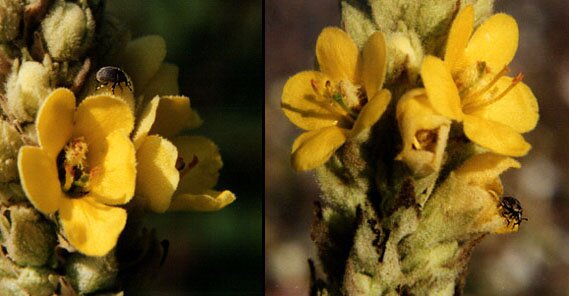
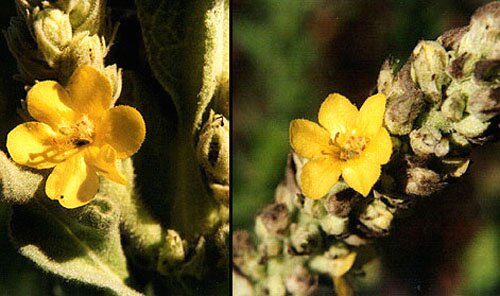
2: Weevils are commonly associated with mulleins, flying from plant to plant and embedding themselves in the flower stalk. Note the typical flower with 5 yellow petals. Usually just several flowers appear at any given time during the blooming season which (in Wisconsin) is throughout July and August.
3: Occasionally one may find flowers with 6 petals.
4: If the developing flower stalk is damaged, several new stalks form around it, sometimes producing a "candelabra" effect. Another example is shown here.
5: Here is a classic sight of mulleins growing along a railroad track. With this group, one can see why they can be referred to as a "choir of mulleins" as noted in the introduction.
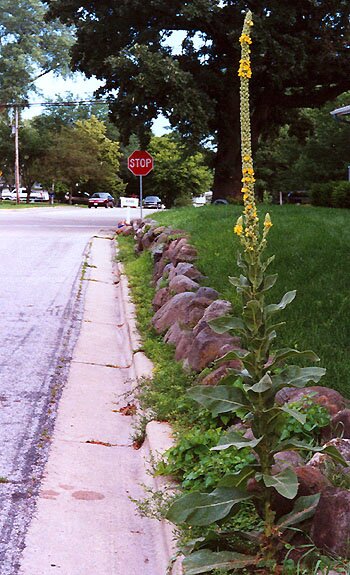
6: And one along a city street in Monona, Wisconsin.
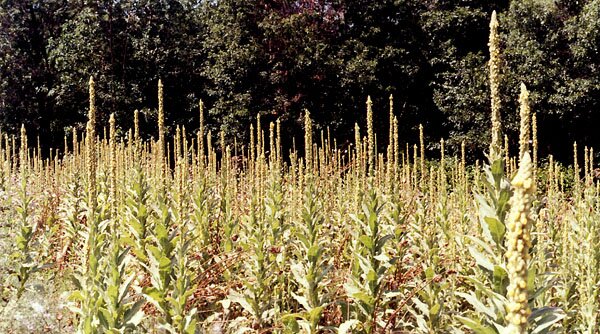
7-8: Along I-94 north of Tomah, Wisconsin was a mullein patch which was apparently the pride of the highway department, as they carefully trimmed around it during the summer of 1998. In late June, the developing mulleins were overshadowed by 8-foot tall thistles (Photo 7). A few weeks later, a thick grove of 6-foot-plus mulleins became the dominant life form (Photo 8).
9: Here is a 60-acre field infested with mulleins. A highly-populated hillside is shown here.
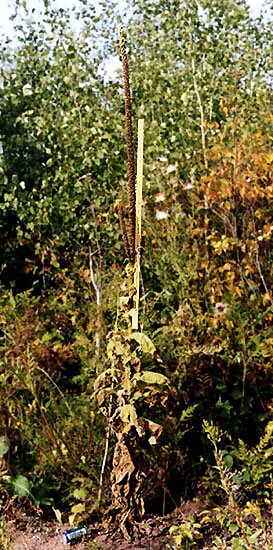
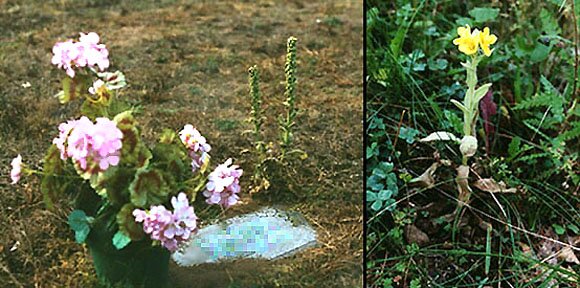
10-11: Here are just about the long and short of it: The specimen in Photo 10 measures approximately 250 cm (about 8 feet 4 inches). The base of the meter stick that is tied to the plant is one meter from the ground. And despite their stunted growth, the plants in Photo 11 are fully-grown as evidenced by their mature flower stalks: Those on the left are just 13 inches tall, and the one on the right (which has a flower arrangement not typical of V. thapsus) measures barely 8 inches.
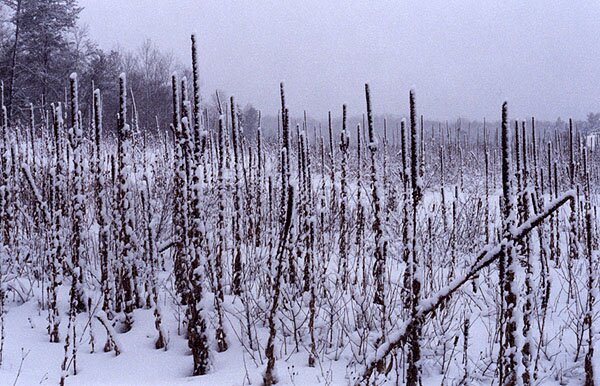
12: Mulleins in the winter.
13: During the warm weather months a variety of creatures can be found on each plant, doing their thing.
14-15: Here is an example of a developmental anomaly called fasciation. In Photo 15 we have an oblique view of the top of the stalk. |
 3 |
 4 |
|
 5 |
 6 |
|
 7 |
 8 |
|
 9 |
||
 10 |
 11 |
|
 12 |
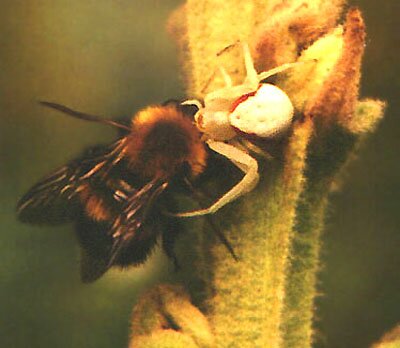 13 |
|
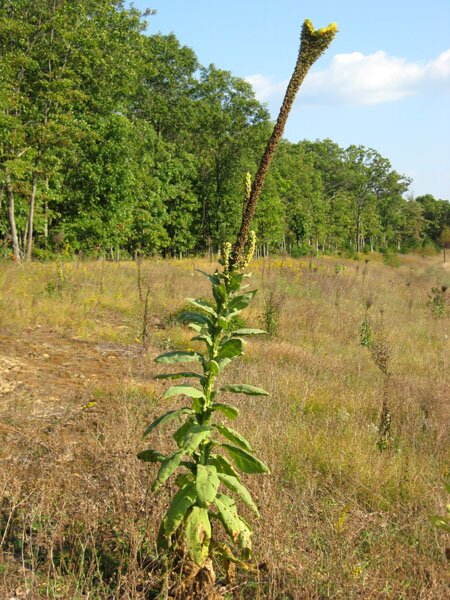 14 |
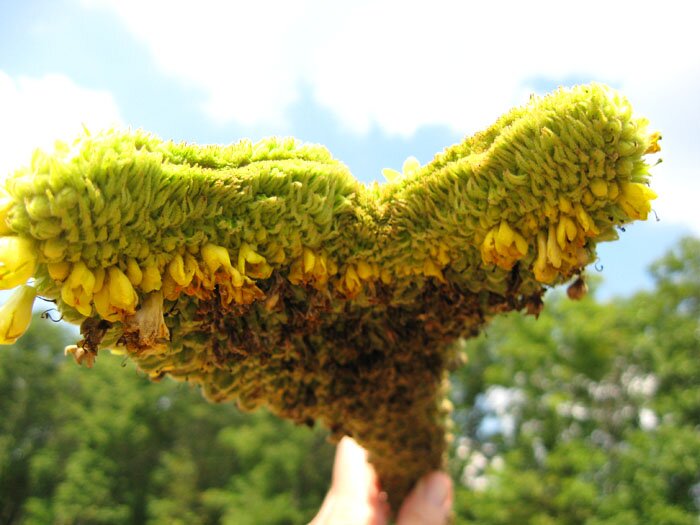 15 |
|
Verbascum thapsus in 3-D!Here we have a field of plants at the end of their second season. While sitting at the level of your monitor, look at both photos, uncrossing your eyes and refocusing on the superimposed images. (You may find this 3-D image "locking" in.)
|
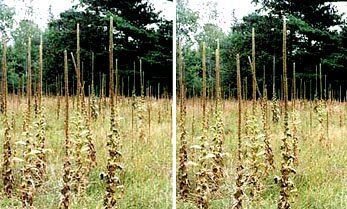
|
Large, placid mulleins, as summer advances, velvety in texture, of a light greenish-drab color, growing everywhere in the fields — at first earth's big rosettes in their broad-leav'd low cluster — plants, eight, ten, twenty leaves to a plant — plentiful on the fallow twenty-acre lot, at the end of the lane, and especially by the ridge-sides of the fences — then close to the ground, but soon springing up — leaves as broad as my hand, and the lower ones twice as long — so fresh and dewy in the morning — stalks now four or five, even seven or eight feet high. The farmers, I find, think the mullein a mean, unworthy weed, but I have grown to a fondness for it. Walt Whitman, as quoted in |
 (not Walt Whitman) |
|
More plants: |
Uploaded in 1997, the mullein page was |